Deployments and rollouts
A Deployment’s detail page carries its ReplicaSets, its revision history and its rollout status, alongside the usual tabs.
Rollout status
Section titled “Rollout status”What the rollout is doing now: how many replicas are updated, ready and available, and whether it is progressing, complete or stuck.
Comparing revisions
Section titled “Comparing revisions”Pick two revisions and the app puts their pod templates side by side.
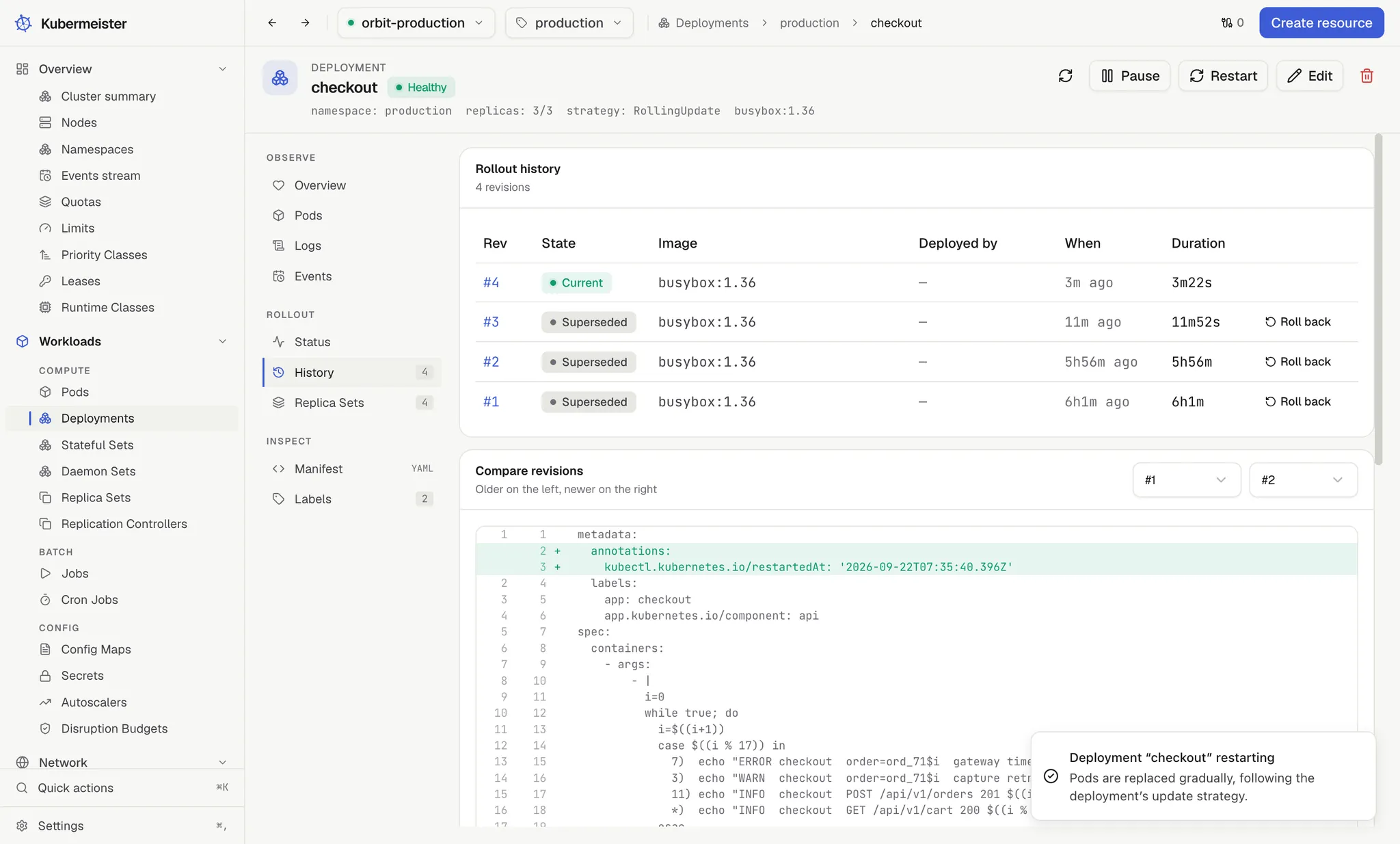
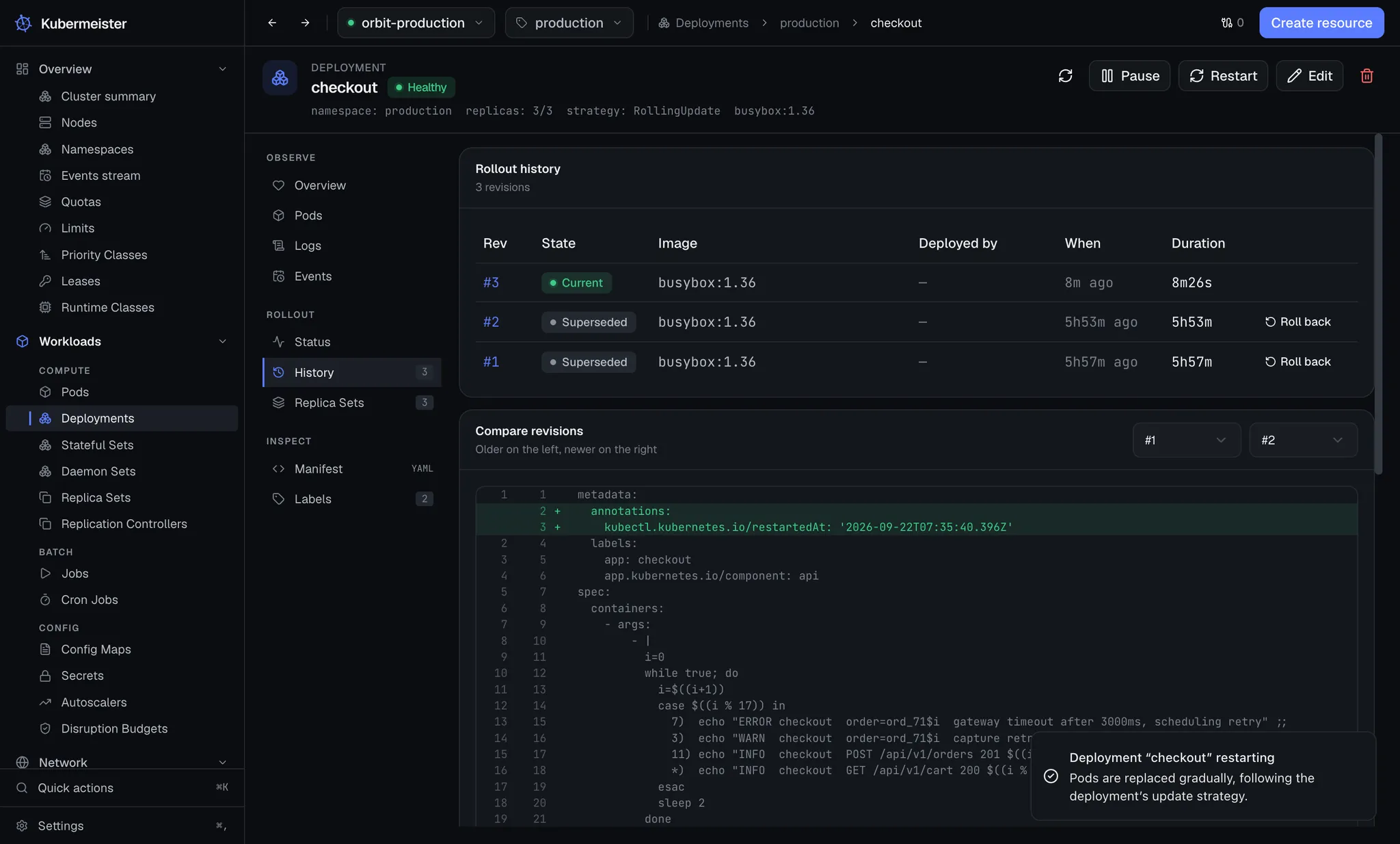
Both sides go through the same canonicalisation the rollback’s skip check uses — keys ordered, blanks
dropped, the controller’s own pod-template-hash label ignored — because the API server fills the two
copies out differently. Without that, a diff is full of differences nobody made.
The diff itself is a plain line diff, so it stays readable and predictable.
Rolling back
Section titled “Rolling back”A rollback restores a revision’s pod template with a JSON patch, never a strategic merge.
That distinction matters: a strategic merge merges container lists by name, so a container added after the target revision would survive the very rollback meant to undo it. A JSON patch replaces the template outright.
If the revision you picked already matches the live template, the app reports it as skipped rather than writing a no-op rollout.
Pausing
Section titled “Pausing”Pause and resume are available from the same place, and go through the same guard as every other write — see writing to the cluster.
ReplicaSets
Section titled “ReplicaSets”ReplicaSets and ReplicationControllers list as their own kinds, each row naming the controller above it from its owner reference. That is the only way to tell two rollouts of one deployment apart.