Settings
Settings live in a versioned JSON file in the app’s own user-data directory. Older versions are migrated forward on load, and one the app does not recognise falls back to defaults rather than failing to start.
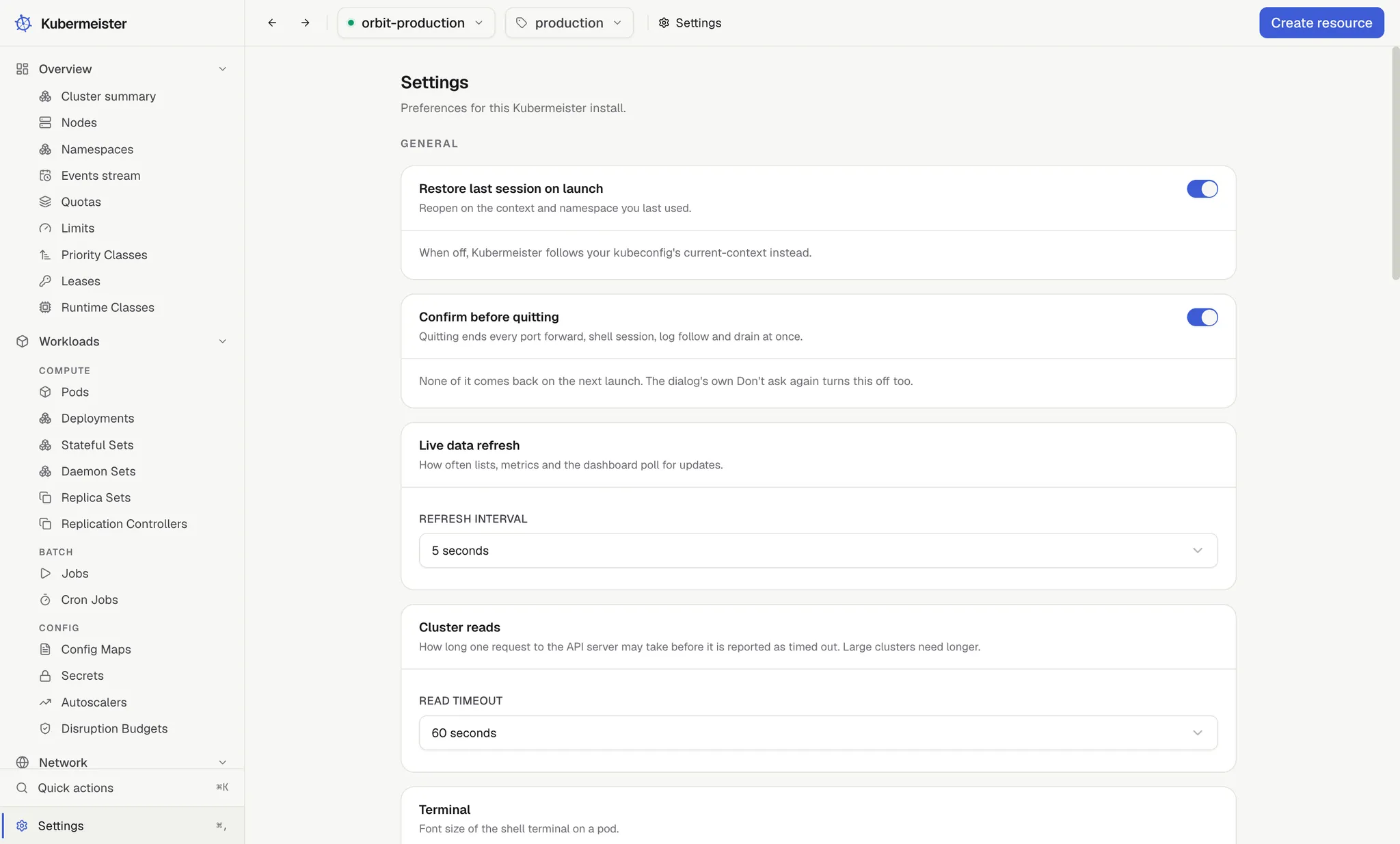
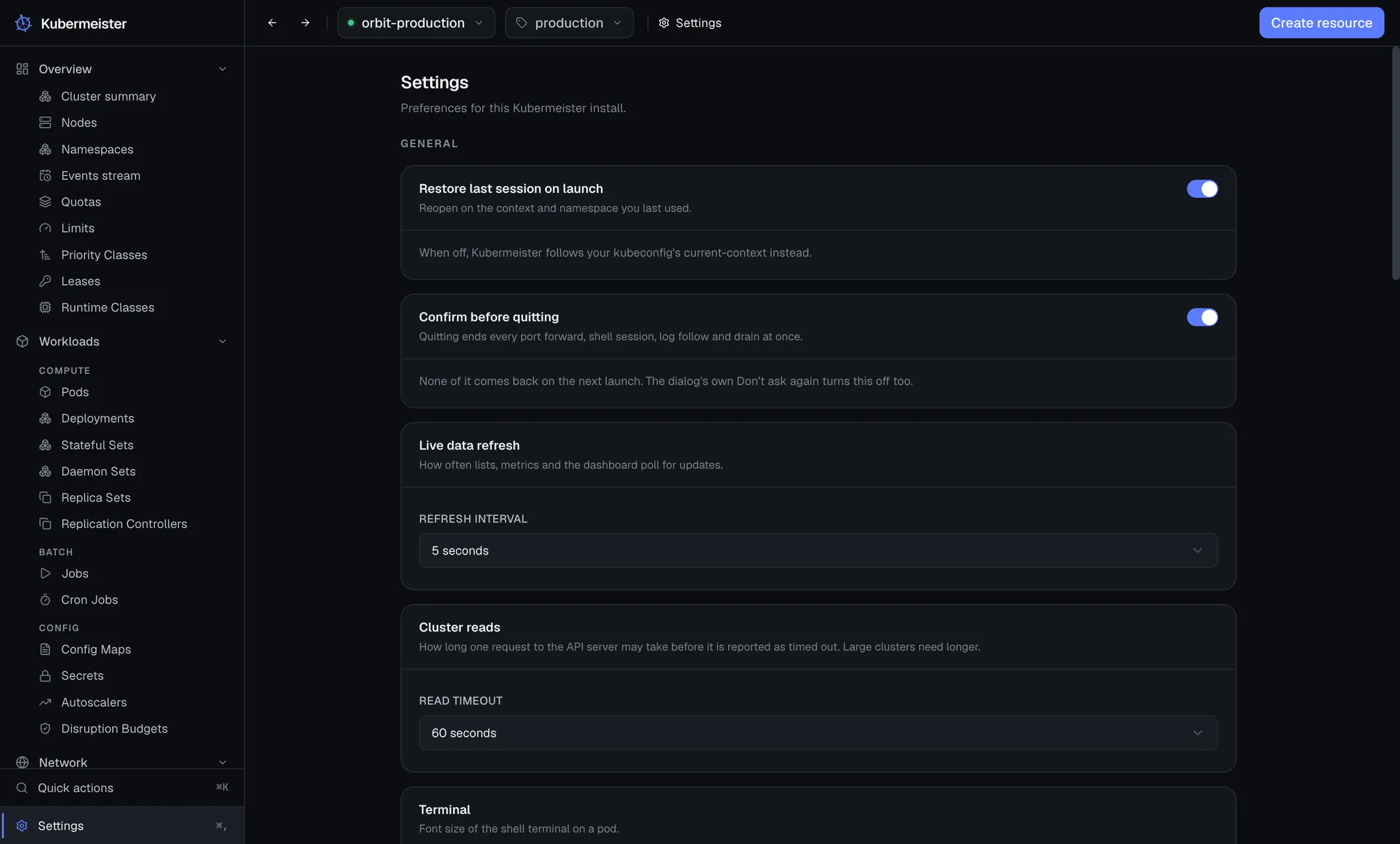
Open them from the sidebar footer, or with ⌘, on macOS.
General
Section titled “General”- Confirm before quitting — whether quitting asks first. On by default, because quitting ends every port forward, shell, log follow and drain at once and none of them come back. See quitting.
- Read timeout (60 s by default) — the ceiling on every cluster call. It both fails the call and aborts it, so a screen that polls cannot pile up requests against a cluster that never answers.
- Refresh interval — the poll cadence for the few things that are polled rather than watched.
- Log buffer lines — how many lines a log console keeps. Read live, so raising it trims differently from the next batch on rather than restarting a follow.
Cluster
Section titled “Cluster”- Kubeconfig — chosen through a native file dialog. The interface can never set a file path itself.
Network
Section titled “Network”- Proxy — a proxy of your own, a bypass list standing in for
NO_PROXY, or no proxy at all. OverridesHTTPS_PROXY/HTTP_PROXYand the kubeconfig’sproxy-url. - Certificate authority bundle — added to what is already trusted, never substituted for it. Also chosen through a dialog.
Changing either ends every stream and reloads the kubeconfig, since both are read once, when it loads. See proxies and certificates.
Updates
Section titled “Updates”- Mode —
download(the default),check, oroff. - Check interval — 4 hours by default, after a short delay at launch.
See updates.
Chart repositories
Section titled “Chart repositories”Chart sources are a fact about your install, not about the cluster you are pointed at, so they are app-level and a context switch leaves them alone.
Three things are kept in step when you add one: the entry in settings, the cached index, and the credential.
- A source is read before it is recorded. An address that answers with no index is refused when you type it, rather than reported as broken from then on. A credential stored for an add that then failed is taken back out of the keychain.
- A password never reaches the settings file. It is sealed with the OS secret store — Keychain, libsecret or DPAPI — and only the ciphertext is written. A system with no secret store is told so rather than written to in the clear, and a credential the local key can no longer open reads as absent.
- A password is refused for a plaintext
httpaddress. That repository is still usable anonymously. - An OCI registry publishes no index, so it is verified the way
helm registry logindoes. Its row shows no chart count, because there is nothing to count.
The theme is stored separately from these settings, because it has to apply before the window’s first paint.
Quitting
Section titled “Quitting”Quitting stops every stream: one action ends every port forward, shell, log follow and drain, and none of them come back. So the app asks first, in a native dialog that names what is about to stop rather than asking in the abstract.
The dialog is the main process’s own rather than the interface’s, because the question has to be answerable when the window never finished loading.
It asks on the two paths you actually take: the Quit menu item, which is what ⌘Q triggers,
and the window’s own close on Windows and Linux, where closing the last window quits.
It does not ask on the paths that are already deliberate and are no moment for a modal — an update’s restart, and a shutdown the operating system asks for.
Turn it off in Settings, or with Don’t ask again in the dialog itself, which is only acted on when you answer Quit: a cancelled action is no moment to write a preference nobody agreed to.