Manifests and YAML
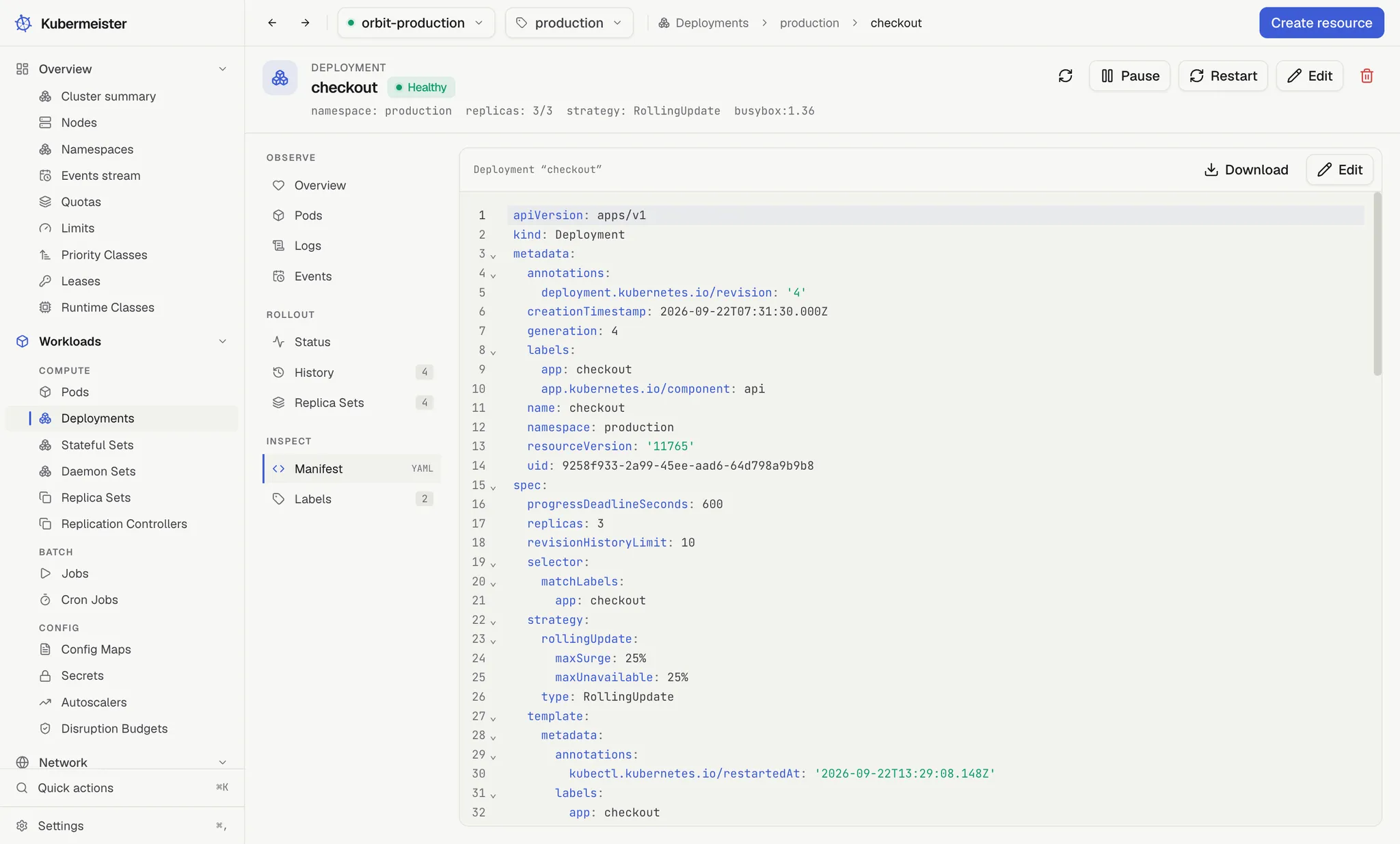
Every object has a Manifest tab showing it as the cluster holds it. Manifests are serialised with plain YAML rather than the client library’s typed dump, which drops fields it does not know about — so what you see is the whole object, including anything a controller or a CRD put there.
Editing
Section titled “Editing”Editing the manifest and applying it is a replace, and a replace must carry the
metadata.resourceVersion the object was read with. That is what turns a concurrent change into a
visible conflict instead of a silent overwrite of somebody else’s edit.

The editor also pins what it was opened on: a manifest naming a different kind, name or namespace is refused rather than applied somewhere unexpected.
Creating
Section titled “Creating”The Create screen takes a manifest and applies it through the same path. The API path is derived from
the manifest’s own apiVersion and kind, so a custom resource rides exactly the same call as a
Pod.
Namespace rules are enforced at the boundary:
- A manifest that names no namespace takes the active one.
- With All namespaces selected and no namespace in the manifest, the write is refused rather than left to a client-library default.
- A kind the app does not recognise is asked of API discovery to learn whether it is namespaced.
Opening a manifest from a file
Section titled “Opening a manifest from a file”A .yaml file dropped anywhere on the window, or picked through File → Open, is staged and opens
the Create screen on it. A file only ever enters the app through the OS — a native dialog, or a real
drag-and-drop — never through a path the interface chose. Both a dropped file and a template ask
before they replace an editor you have already typed in.
Secrets
Section titled “Secrets”A Secret’s Manifest tab shows the object as the cluster holds it, values included, because that is what editing it requires. Everywhere else, values are handled one key at a time — see security.